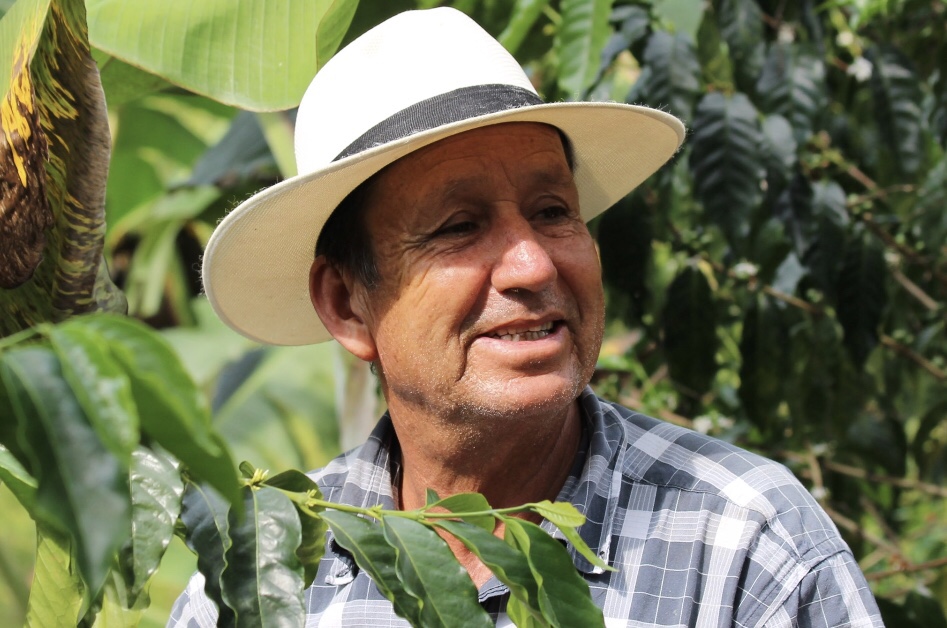
For the last two weeks Abi and I have been working on a coffee farm in Colombia’s zona cafeteria. The owner of the farm, Don Leo, has a fascinating story that began in 1953 and is today told to visitors from around the world.
Don Leo was born into a very poor family. He had 16 siblings and his family would work on one of the farms in the region. Despite the poverty, the farm owners treated him and his family like their own and Don Leo ate, slept and played at the farm.
As a result, life for a young Don Leo was pretty good and he dreamed of one day having his own farm to share with his workers.
He did not go to school but learned to read and write before starting work on the farm aged 9.
Being a part of daily life on the farm had its drawbacks as the children would be introduced to vices such as drinking, smoking and gambling from an early age. From the age of 12 he was drinking aguardiente and smoking marijuana. At the time this was a normal part of the culture and therefore not frowned upon at all!
This was how he and many Colombian coffee farm workers lived until the 18th July 1975 when a natural phenomenon 4000 miles away changed the course of Colombian history forever.
Forty eight hours of snow in the Brazilian state of Parana wiped out millions and millions of coffee trees and crippled the coffee industry.
Overnight Colombia had become the biggest and most important coffee producing nation in the world and the price of coffee soared.
Within a few weeks the price had multiplied 7 fold and the coffee farm owners of Colombia had become extremely wealthy.
Naturally, the government of Alfonso López Michelson took advantage of this and prices across the country were raised. In fact the only thing that did not increase was the salary of coffee workers and this plunged them into even deeper poverty.
At this time the Revolutionary Armed Forces of Colombia (FARC) were a small group of guerrillas who were struggling to make an impact in the Colombian countryside.
The sudden boom in the coffee market and subsequent poverty of the farm workers, gave them the perfect platform to spread lies among the rural population.
With the promise of peaceful protests against the government, tens of thousands of campesinos (farm workers) were convinced to join the guerrillas.
But very quickly these farmers realised that they had been deceived as the guerrillas did not lead peaceful proetests for social change. Instead the guerrillas taught them to kidnap, rape and kill. Many tried to escape but were rounded up and brutally murdered in front of fellow farmers.
As the guerrillas spread fear across the countryside, some of the wealthy farm owners took advantage of the plight of the workers and smaller farm owners by buying all of the land at low prices. These farm owners would pay a tax to the guerrillas and in exchange would be allowed to combine a number of farms into larger haciendas.
Here they would build luxurious houses that were out of bounds to the workers. Instead the campesinos would sleep in purpose built hen houses (sometimes housing up to 200 workers) and would not have any bathrooms.
A man known as ‘Alimentador’ (the feeder) would be given money to go and buy food for the workers and he would return with the rotten food that no one else wanted (he would pocket the left over money for himself).
As a result, many farm workers became Nomads…moving across the Colombian countryside in search of farms to work on.
Don Leo was no different and in the early 1980’s was told about a great opportunity in the Sierra Nevada region not far from the Carribean coast. Here, the mountainside was littered with hundreds of thousands of coffee trees and workers were paid three or four times as much.
Don Leo sold all of what he had and made the two day bus trip to the Sierra Nevada.
But when he and the many other farm workers arrived they immediately knew that they had been deceived yet again. This region did not have a single coffee tree…instead there were scores of marijuana plants littering the landscape.
Don Leo and his fellow farmers had nowhere to sleep, no food to eat and no money to return home. They had no choice but to ask for work picking marijuana.
This is extremely exhausting work but the good thing was that the promise of more money was true. Here, Don Leo would earn around 2500 pesos a month which was three times more than he had done previously.
Don Leo would work for two or three months at a time and then return home for a week or two with the money that he had earned.
After a short time working on the marijuana plantations, many workers were moved on by the drug traffickers, who had bu this time turned their attentions elsewhere.
When Don Leo was first asked to pick coca he had no idea what it was. He just presumed it was some kind of tea like the Argentine yerba.
One day when he was working in the fields, Don Leo overheard someone talking about a laboratory. His curiosity got the better of him and his thoughts turned to a highly modern and technological work space.
He asked his boss if he could see this laboratory and the man agreed to show Don Leo.
It was not modern at all. It was a large plastic tarpaulin clinging to the side of the mountain under which barrels of chemicals were mixed together. Fascinated, Don Leo would go to the laboratory every day after finishing his work in the fields.
Over the course of four or five days, Don Leo noticed a change in the man in charge of mixing the chemicals. What had previously been a strong and sure handed farmer had become a man with trembling hands. Don Leo knew that this man had contracted Malaria and he could not have been happier…this was his chance.
In hindsight Don Leo is ashamed of these thoughts as at the time he gave no consideration to the man’s health and only worried about his own ambitions. But at the time, he says, the only thing anyone cared about was survival and money.
A few days later the man was forced to ask Don Leo for help and within a week had been forced to hand over responsibilities entirely.
“Like making a soup” was how Don Leo described the process and just like that he had become one of the key cocaine chemists for the most powerful drug cartel in the world.
It was at this time that Don Leo started to become aware of what cocaine really was. The chemicals involved in making it, and the dangers of consuming it.
The job was perilous because the people who he now associated with were some of the biggest kingpins in Colombia.
As a result Don Leo and four of the other workers were convinced that they would be killed, so locked themselves in a room and smoked 2kg of cocaine between them so that they would not feel the pain of death.
Don Leo somehow survived this and the next couple of months mixing chemicals for the narcos. One afternoon a plane flew overhead and dropped a large package filled with money to pay the workers.
When Don Leo received his wage he nearly died of happiness. It was as if he had won the lottery because two months work had earned him 180,000 pesos! This amount of money made him feel incredibly important and powerful.
But later that night Don Leo could not sleep. He remembered his up bringing and the values that had been instilled in him by his parents and grandparents. It was at this moment that he realised who he had become…the person that he despised most in the world.
He thought of the damage that the cocaine was doing on families and did not want his own son (at this time a few months old) to grow up in a world fraught with danger.
Without a seconds thought about his safety or the perils that lay ahead…Don Leo escaped into the night.
For four days he wandered the dense jungle in search of civilisation and eventually reached a small town where he found food and shelter. He also required medication as he had contracted malaria.
When he had recovered his strength Don Leo began the journey home to his family. He used the money he had earned to create a new life for them, buying a television and investing in a small shop.
Over the next 20 years Don Leo expanded his business and obtained a number of properties, living a very comfortable life with his wife and son. In spite of all of this something was missing.
In 2009 Don Leo decided to sell everything that he owned so that he could buy his own farm and realise the dream that he had as a boy.
He bought an abandoned farm in the valley below the small town of Buenavista and set his sights on building a farm that would operate in the same vein as the one that he had lived on as a child.

In 2013 the first coffee harvest was ready and Don Leo proudly took it to sell to the Colombian Coffee Federation. They paid him half of what it cost to produce.
This destroyed Don Leo and his dream was shattered. He returned home distraught…his dreams in tatters. How could anyone survive as a coffee farmer when the federation paid next to nothing for the produce.
Don Leo told his son Diego (by now in his 30s) and wife Yamille that he might have to return to working in for the narcos as it is the only way to earn a good living in Colombia.
Diego told his Father that he would not allow him to return to the jungle and instead urged him to commercialise his coffee and cut out the corrupt middle man.
They started producing higher quality coffee beans by restructuring the process and sorting the beans accordingly. Don Leo soon realised that Colombians were not interested in paying more for a better quality product.
To counter this problem, he decided to start running tours for foreign visitors. This way he could tell them his story as well as showing off his coffee farm. Visitors would be encouraged to buy the high quality coffee while the remaining (low quality coffee) was sold to the federation.
Today La Alsacia is a thriving coffee farm. Visitors from all over the world come to hear the incredible story of Don Leo and sample the finest coffee in Colombia.
The workers on the farm are paid a fair salary, they are given accommodation if they require it and there are no fewer than 7 bathrooms! Each worker receives three meals per day and is treated as part of the family.
As our time at the coffee farm drew to a close, the declining health of Don Leo was clear to see. In the past he has suffered two heart attacks and spent many months in a psychiatric clinic with PTSD. But this man is a survivor.
We can only imagine the parts of the story that he leaves out and this must play on his mind every day as he relives his life for the benefit of tourists.
He says it is necessary.
“When the world thinks of Colombia they think of drug traffickers, guerrillas, paramilitaries and violence. I want to show the world that we are more than that and that we are not defined by our dark past. The real Colombia is family values, beautiful nature and, most importantly, the best coffee in the world!”
 Honey Year Travels